
By Allan Huang, Analyst \ March 2026
As global industries expand and electricity demand rises, attention often centres on power generation. Less visible, but equally critical, is energy storage. Batteries determine how energy is stored, transported, and deployed across mobility systems, grid infrastructure, and industrial applications.
Lithium-ion batteries have become the dominant rechargeable storage technology over the past three decades. First commercialized by Sony in 1991, they enabled the rise of portable electronics. Today, they underpin electric vehicles, utility-scale storage systems, and much of the modern electrified economy.
Despite their maturity, lithium-ion systems are still evolving. The question is not whether performance will improve, but where the limits lie and what the next phase of advancement will look like.
At its core, a battery is an electrochemical device. It stores energy in chemical form and releases it as electricity through the controlled movement of ions between two electrodes.
Three metrics define the performance of any rechargeable battery system:
Energy density
The amount of energy stored per unit weight or volume.
Charge rate
The speed at which energy can be added or withdrawn without damaging the system.
Cycle life
The number of charge and discharge cycles a battery can undergo before significant degradation, typically defined as a 20 percent reduction in usable capacity.
Using electric vehicles as an example makes these metrics intuitive:
• Energy density determines range.
• Charge rate determines refueling time and acceleration capability.
• Cycle life determines usable lifespan.
Recent lithium-ion systems entering commercial markets can approach 600 kilometres of range, sustain approximately 1,400 cycles with limited degradation, and in some cases achieve full charge in roughly 12 minutes under controlled conditions. Demand growth projections for batteries remain strong through 2030.
Yet chemistry still imposes constraints.
Every lithium-ion battery contains three core components:
1. A positive electrode (cathode)
2. A negative electrode (anode)
3. An electrolyte that enables lithium-ion transport
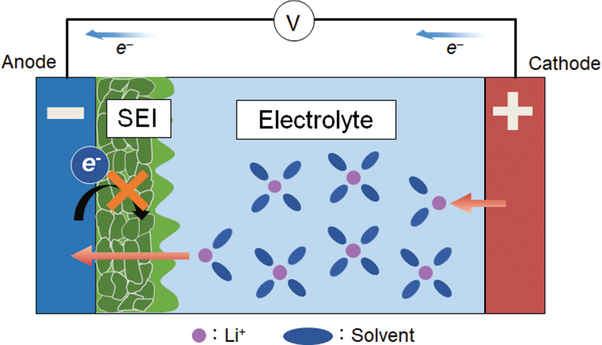
The electrodes are composite structures consisting primarily of active material, along with conductive additives and binding agents. During charging, lithium ions move from the cathode into the anode. During discharge, they return.
Where the liquid electrolyte meets the electrode surface, a thin layer forms during initial charging. This layer, known as the solid electrolyte interphase (SEI), plays a critical role in long-term performance. It allows lithium transport while protecting the electrode surface. However, instability in this layer can reduce cycle life, limit fast charging capability, and in extreme cases lead to lithium dendrite formation that may cause short circuits.
Advancement in lithium-ion performance increasingly depends on controlling this microscopic interface.
Source: ResearchGate, “Frontiers in Theoretical Analysis of Solid Electrolyte Interphase Formation Mechanism”
Modern lithium-ion batteries rely primarily on two cathode chemistries:
Nickel Manganese Cobalt (NMC)
High energy density and well-understood performance characteristics, but relatively shorter cycle life and reliance on cobalt.
Lithium Iron Phosphate (LFP)
Lower energy density but improved cycle life, strong charge rates, and lower material cost.
On the anode side, graphite remains the industry standard. It is inexpensive and reliable but limited in how much lithium it can store. To increase energy density, manufacturers increasingly incorporate small percentages of silicon into graphite. Silicon offers higher storage capacity but expands significantly during charging, creating mechanical stress and potential cracking that can reduce cycle life.
Conductive additives such as carbon black remain widely used. However, advanced nanomaterials, including carbon nanotubes and graphene, offer higher conductivity and enable faster charging, though cost and manufacturing consistency remain challenges.
Electrolytes are typically organic liquids, which provide effective ion transport but introduce flammability risk. Research continues into improved additives and solid-state electrolytes aimed at enhancing safety and stability.Each material choice represents a balance between cost, manufacturability, safety, and performance.
The next generation of battery technologies is under active development. Several approaches aim to increase energy density, reduce reliance on scarce materials, and improve safety.
Lithium-Rich Manganese Oxides (LMRO)
Potential for significantly higher energy density, though cycle life remains a concern.
High-Voltage Spinel Chemistries (LNMO)
Cobalt-free alternatives with attractive cost characteristics and strong theoretical performance, but manufacturing precision remains challenging.
Lithium Metal Anodes Paired with Solid Electrolytes
Often described as a breakthrough pathway, these systems could meaningfully increase energy density while reducing fire risk. Remaining challenges include cycle stability, low-temperature performance, and large-scale manufacturability.
Sodium-Ion Batteries
Lower energy density than lithium-ion but strong low-temperature performance and attractive cost profiles. These systems may complement lithium-ion in grid storage and specific vehicle applications rather than replace it.
Commercial timelines for many of these technologies fall between 2026 and 2030. Some may scale earlier; others may remain niche.
Lithium-ion technology is not at a performance ceiling. Incremental improvements in materials science, interface control, and manufacturing precision continue to push energy density, charge rate, and cycle life forward.
At the same time, emerging chemistries aim to address structural limitations in safety and longevity.Battery performance directly influences the economics of electric vehicles, renewable integration, and grid stability. As electrification accelerates, energy storage becomes increasingly strategic.
Evaluating material constraints, scalability challenges, and performance trade-offs is essential to identifying where durable long-term value may emerge across the battery supply chain.
Get the latest market insights and
research delivered directly to your inbox.
Intelligent exposure to the global energy transition.