
By Allan Huang, Financial Analyst
For most of human history, economic growth and pollution moved together. Producing more goods required burning more fuel. Expanding transportation meant consuming more coal, oil, or natural gas. Growth came with rising emissions; that relationship is now changing.
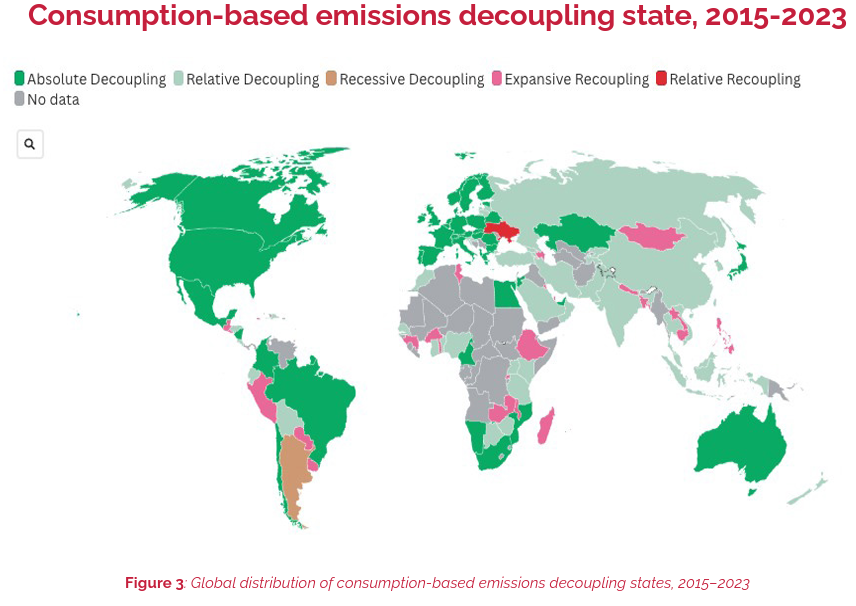
Recent global data shows that many of the world’s largest economies are expanding while reducing greenhouse gas emissions. Countries representing the vast majority of global GDP are now experiencing either relative or absolute decoupling between economic growth and emissions.
Between 2015 and 2023, economies including Canada, Japan, Australia, Mexico, South Africa, and much of the European Union grew while lowering annual emissions. This analysis uses consumption-based accounting, meaning emissions embedded in imports and exports are included. ¹
Economic expansion no longer requires proportional increases in carbon output.
Energy underpins every modern economy. It powers industry, transportation, heating, cooling, food production, and digital infrastructure. Access to affordable and reliable energy determines productivity, employment, and income growth.
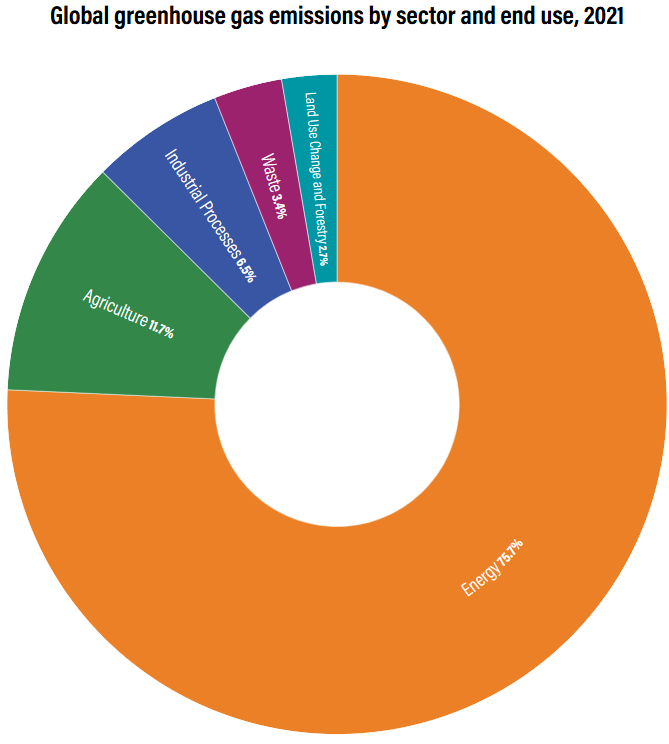
The energy sector also remains the largest contributor to global greenhouse gas emissions, responsible for roughly three-quarters of the total. Around 80 percent of the global energy supply still comes from fossil fuels.Energy demand is not declining; it’s growing. The defining question is how that energy will be produced.
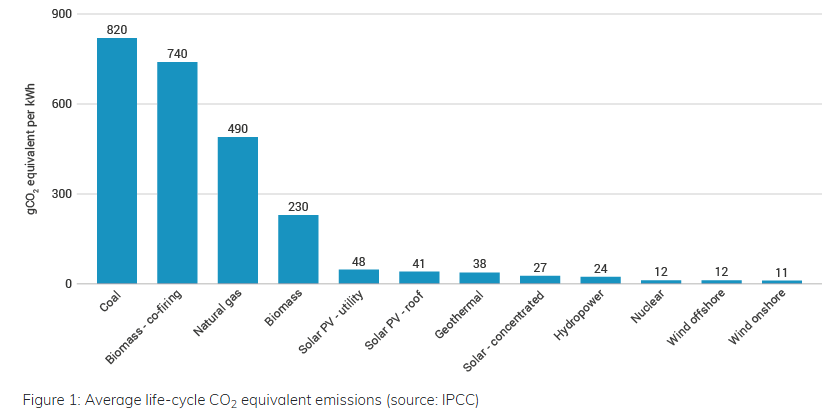
When lifetime emissions are compared across energy sources, the advantage of clean electricity becomes clear. Wind, solar, hydropower, and nuclear generate significantly lower lifecycle emissions than coal or natural gas.
For governments and corporations seeking to reduce carbon intensity without sacrificing output, electrification offers a practical solution.
This is not only an environmental shift. It is an economic one.
The levelized cost of electricity measures the full lifetime cost of building and operating a power generation asset. On this basis, onshore wind and utility-scale solar are now among the lowest-cost sources of new electricity generation in many markets.
Cost competitiveness changes the investment landscape. Clean electricity is increasingly viable without heavy subsidy support. In many jurisdictions, it is simply the most economical option.Intermittency remains a technical challenge. Solar does not generate power at night, and wind output varies. However, the cost of utility-scale battery storage has declined dramatically over the past decade. Storage systems are now being deployed at scale to stabilize grids and smooth renewable output.
Meanwhile, efficiency gains in conventional fossil fuel systems have slowed. As renewable generation and storage technologies continue to improve, the economic position of fossil fuels becomes less favourable over time.
Electrification is emerging as both a cost-efficient and lower-emissions pathway.
Progress is not uniform across all countries. Policy shifts, commodity prices, infrastructure constraints, and energy security concerns can temporarily reverse gains.
However, the broader global trend remains intact. Many large economies are reducing emissions intensity while continuing to grow. Clean electricity plays a central role in that shift.The historical assumption that prosperity requires rising pollution is weakening.
Energy systems evolve over decades. Infrastructure investments are long-lived. Yet when economics, technology, and policy align, transitions can accelerate.The evidence increasingly supports a structural shift toward electrification. Clean electricity delivers lower lifetime emissions and, in many markets, lower costs. Storage technologies continue to improve. Industrial electrification is expanding. Capital allocation is increasingly flowing toward modern grid and energy systems.
Economic growth no longer requires proportional growth in emissions. The data demonstrates that separation is not theoretical. It is already occurring across much of the global economy.Electrification is not a cyclical trend. It is a reconfiguration of how economies generate, distribute, and consume energy.
Get the latest market insights and
research delivered directly to your inbox.
Intelligent exposure to the global energy transition.